
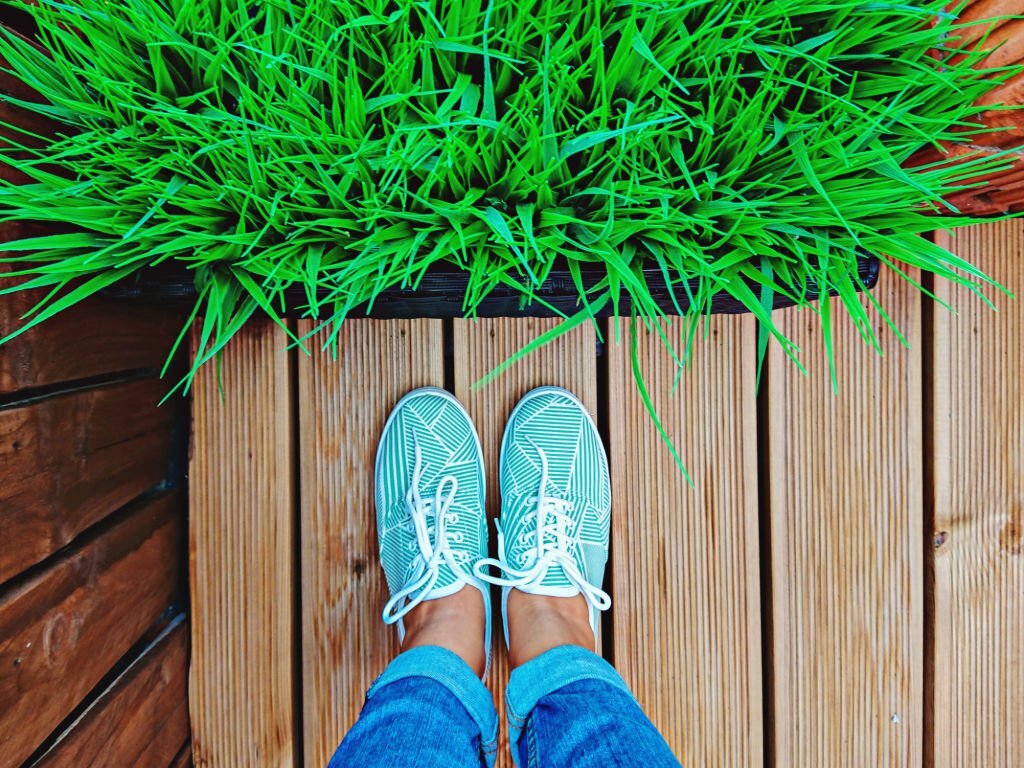
Artificial grass is the only alternative to equip a terrace or balcony with a decorative lawn. It can be laid permanently on all smooth surfaces without any problems. Built-in drainage allows the moisture to drain away so that there is no waterlogging when it rains. The lawn can remain on the balcony or terrace in summer and winter, frost temperatures don’t bother it much. The lawn creates a pleasant surface that is pleasant to walk on barefoot and that gives the balcony or terrace a homely look. Due to the modern types of artificial turf, the lawn can hardly be distinguished visually from natural lawns.
-
The preparation of the subsoil
A smooth surface on which the lawn is to be laid is important. The terrace or balcony is completely cleared and the floor is smoothed. Unevenness must be removed, otherwise, the artificial turf will tear or there will be dangerous tripping hazards. It doesn’t matter whether the floor is made of concrete, tiles or stones. Thanks to the good drainage properties of modern types of artificial turf by Reform Sports, almost any surface can be equipped with a green lawn.
Preliminary work on the terrace or balcony is not necessary. Only the measurement has to be done. The length and width of the balcony or terrace are determined with a meter so that you know how much lawn you need. The following items are required to lay artificial grass:
1. sufficient amount of artificial grass
2. tape measure
3. sharp knife or carpet knife
4. artificial grass glue
5. fastening anchors if necessary
-
Lay artificial grass on the balcony or terrace
It is particularly easy to lay artificial turf on the balcony or terrace, as the subsoil is usually level and firm. Elaborate preparatory work is not necessary here. All you have to do is make sure the surface is clean and dry. Cracks and holes should be evened out before laying the artificial turf.
For smaller areas up to around 20 m², there are special mats with knobs on the underside that are laid out loosely. The nubs ensure that the covering is well aerated. However, it is advisable to lift the lawn carpet from time to time after laying it so that no mould can form. On larger areas from 20 m², the artificial turf should be glued.
Step 1: Layout fleece and artificial turf
Layout a fleece on the prepared sandy soil. It stabilizes the artificial grass and prevents weeds from getting through. It should protrude about 10 cm at the edges. If you need several lengths, let them overlap by about 10 cm. Fix the Geofleece in the corners with artificial grass anchors. If you want to lay your artificial turf on the balcony or a terrace with a concrete subfloor, you don’t need fleece.
Now you can tackle the artificial turf. Align the strips in such a way that the individual blades of grass point against the mainline of sight. This way you can look into the lawn later, which makes it appear fuller. Unroll the artificial grass and smooth out the folds. Attention: The position of the tracks can only be corrected with difficulty later. It is best to get a second person to help. Use a sharp cutter to cut the lawn carpet to the desired length. Leave a small overhang of about 10 cm.
Step 2: Fix seam connections and outer edges
There must be no gaps between the individual tracks. Fold over the two edges and cut a strip 3 cm wide on both sides. This will give you a clean edge. But don’t damage the underlying stalks or the fleece! Glue a seam tape to the substrate in the middle under the seam. Then press the edges onto the adhesive strip as firmly as possible. if you lay the artificial turf on earth, you fix it at the outer edges every 50 cm with special artificial turf anchors. On the balcony or terrace, you use tape. Once you have positioned the artificial turf perfectly, you can neatly cut off the excess at the edges.
Step 3: Sand artificial grass after laying
Now distribute the quartz sand evenly on the artificial turf (about 4-5 kg per m²). For larger areas, this is best done with a spreader. Now all you have to do is brush the artificial turf with a hard broom so that the blades align perfectly – and you can enjoy your green oasis.
By laying artificial turf, you can create green islands of well-being even on difficult surfaces. Especially in damp and shady locations, it is a good alternative to laying natural grass. But artificial grass also creates a natural atmosphere on the terrace and balcony. It is particularly useful for rented apartments because the panels can be removed easily and without leaving any residue.
Although artificial turf is easy to care for, it also needs a little attention from time to time: so that you can enjoy the green surface for a long time, you should remove leaves and weeds regularly. A street broom is sufficient for cleaning, but a conventional vacuum cleaner also works well on the balcony or terrace. You can remove stubborn dirt and stains with warm water, an all-purpose cleaner and a carpet brush. It is also advisable to brush the lawn vigorously from time to time.